
Engineering information is an information supply chain
EIM is managing engineering data, documents, roles, responsibilities and dates with their relationships throughout the complete asset lifecycle.
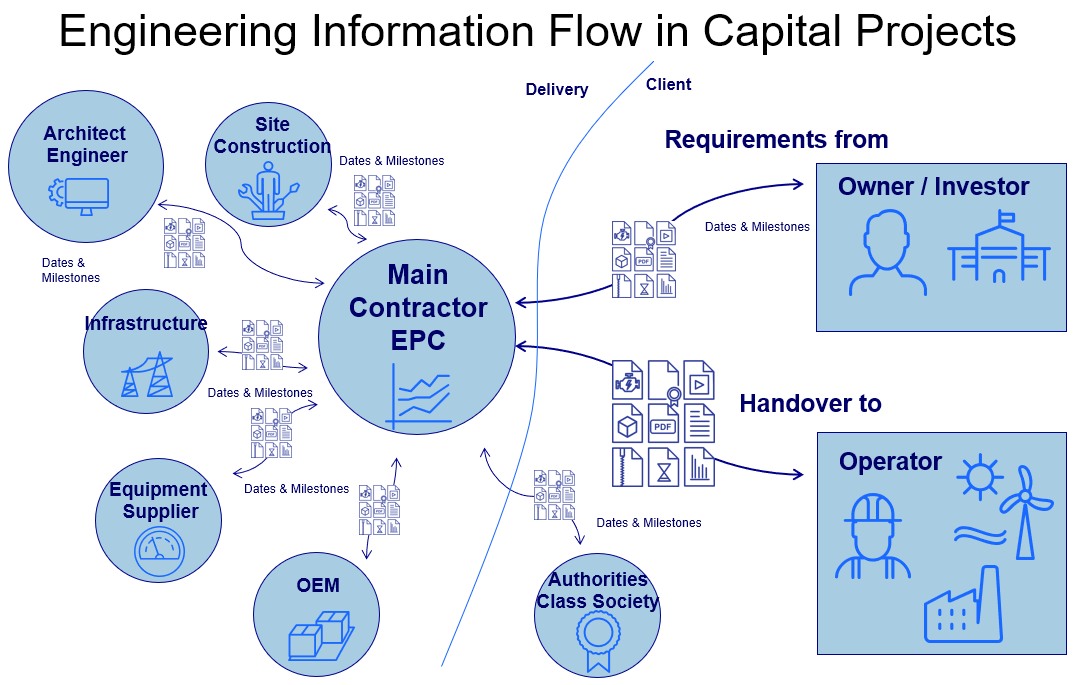
Figure 1: Engineering Information Management in capital projects – information requirements flow from the Owner into the project delivery organization, while verified engineering and asset information is handed over to the Operator.
A capital project to build a production plant, an oil rig, a utility asset or an infrastructure facility does not create engineering information in one place. Information is produced, reviewed, exchanged and changed by many different organizations and disciplines over many years.
On the delivery side, the Main Contractor or EPC acts as a central integration point. Engineering organizations, site construction teams, infrastructure contractors, equipment suppliers, OEMs, all create and exchange information. Every participant has specific deliverables, responsibilities, review cycles, contractual dates and project milestones.
On the client side, two perspectives have to be distinguished.
The Owner or Investor defines what the project has to deliver. Requirements therefore flow from the client into the delivery organization. The Operator, however, needs the resulting engineering and asset information to operate, maintain and modify the facility safely and efficiently. Information therefore flows in the opposite direction during handover.
The EPC sits between these flows and orchestrates a complex network of engineering organizations and suppliers. It has to ensure not only that the physical asset is delivered, but also that the required information is complete, correct, approved and available at the required milestones.
This concept extends the original EDM-ADM model. Project Information Management and Asset Information Management are two different application contexts, but they have to be integrated. The connecting process is Information Handover. The existing EDM-ADM “Main Concepts” already establish this principle and also make clear that Engineering Document Management and Asset Document Management are essential parts of the broader information-management process. EDM-ADM Project
Engineering Information Management, or EIM, develops this model further.
It considers not only documents, but the complete network of:
Engineering data, documents, models, tags, equipment, requirements, organizations, roles, responsibilities, dates, milestones, revisions and their relationships.
An engineering document is therefore no longer regarded simply as a file in a document-management system. It is an information object with a context.
A pump datasheet, for example, may be related to an equipment tag, a supplier, a purchase order, a document requirement, an engineering discipline, a responsible engineer. It has a planned submission date, a review deadline, a project milestone, and eventually an equipment object in the operator's asset-management system.
Managing these relationships is at the heart of modern Engineering Information Management.
Author: Jens Friehmelt is a Senior Manager in OpenText Professional Services EMEA leading an international team that combines multiple OpenText technologies to serve customers with best-practice solutions for Engineering, Construction, and Maintenance processes.