
Goals and Tasks of EIM Project Information Management
The purpose of Engineering Information Management is to ensure that the information required to design, procure, construct, commission, hand over and operate an asset is available completely, in the required quality, to the right people and systems, and at the right point in time.
In a capital project, this requires much more than storing engineering documents. EIM has to coordinate information requirements, technical objects, documents, responsibilities, review processes, contractual commitments and project dates across a complex network of owners, EPCs, engineering companies, contractors and suppliers.
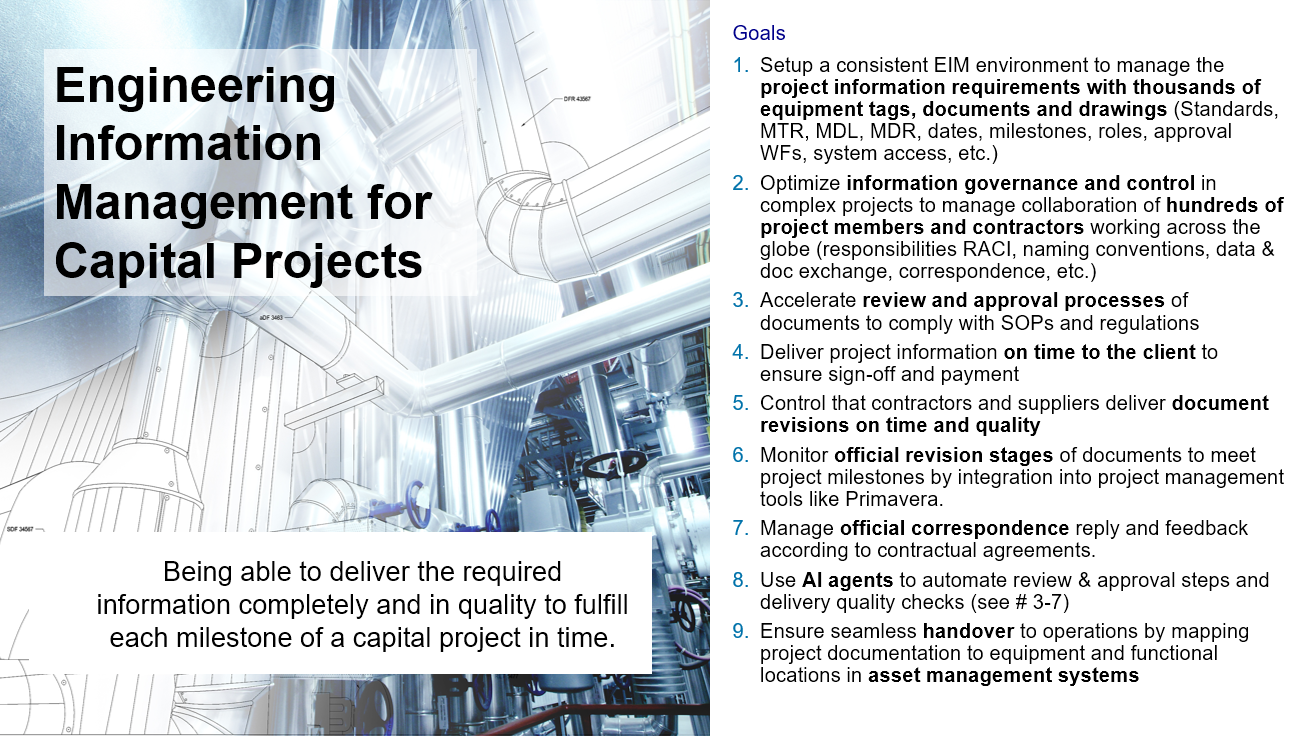
Figure 4: Goals and tasks of Engineering Information Management in capital projects. EIM connects project information requirements, engineering objects, documents, responsibilities, review and approval processes, project milestones and the final handover to Asset Operations.
The figure summarizes the principal goals of EIM in a capital-project environment. Its central message is:
EIM must enable the project organization to deliver the required information completely and in the required quality in order to fulfil every project milestone on time.
This makes information delivery an integral part of project delivery.
EIM links information delivery with project delivery
The nine goals and tasks illustrated in Figure 4 can ultimately be summarized by one principle:
The project must manage engineering information with the same discipline with which it manages cost, schedule, procurement and construction.
Information has requirements.
Information has owners.
Information has suppliers.
Information has revisions.
Information has quality criteria.
Information has approval processes.
And information has due dates.
Engineering Information Management brings these dimensions together.
It creates the framework that allows a project to control not only what has to be built, but also what information has to be delivered about what has been built.
This capability becomes increasingly important as the project approaches commissioning and handover, because physical completion without reliable engineering and asset information does not create an operationally ready asset.
Establishing a consistent EIM environment
The first task is to create a consistent information-management environment in which the project can manage thousands of equipment tags, documents, drawings and other engineering information objects.
This environment includes structures such as the Master Tag Register (MTR), Master Document List (MDL), Master Deliverable Register (MDR) and dates and milestones defining what information has to be created and delivered.
But an EIM environment also has to manage the context surrounding these information objects: planned dates, contractual milestones, responsible organizations, responsible roles, revision stages, approval workflows and system access permissions.
An engineering document is therefore not managed only by its document number and revision. It has relationships to technical objects, organizations, people, deliverables and dates.
These relationships allow EIM to answer questions such as: Who is responsible for this deliverable? When is it required? Which milestone depends on it? Which equipment does it describe? Which revision has been approved?
This is one of the fundamental differences between simple document storage and Engineering Information Management.
Information governance across complex project organizations
Large capital projects involve hundreds or sometimes thousands of people working for many different organizations.
The Owner, EPC, engineering contractors, construction contractors, equipment suppliers and OEMs may all participate in the same information processes.
EIM therefore has to establish clear information governance.
Responsibilities should be defined through organizational structures and models such as RACI. Naming conventions, numbering systems, metadata requirements, document classifications, exchange rules and information workflows have to be applied consistently across organizational boundaries.
The objective is not to force every organization to work in exactly the same way internally. The objective is to create a common information-management framework at the interfaces between the organizations.
This framework defines who must deliver what information, to whom, in which quality/maturity and by which date.
Controlling review and approval processes
Engineering documents and data frequently pass through several review and approval cycles before they can be used for detailed design, procurement, construction or As-build (revision cycles).
One of the central tasks of EIM is therefore to accelerate and control these processes.
Documents have to be routed to the correct reviewers, review deadlines need to be monitored and comments must be consolidated and returned to the originating organization.
At the same time, the process must comply with the project's procedures, contractual requirements and applicable regulations.
EIM must ensure that the project can monitor which information must be submitted, who must review, which comments were made, who must approve it and which revision became authoritative.
Managing information against project dates and milestones
Information has a schedule just as engineering, procurement and construction activities have schedules.
A drawing may be required before an equipment package can be ordered. A supplier datasheet may be required before detailed engineering can be completed. Approved construction information is required before installation starts. Certificates and as-built documentation may be prerequisites for commissioning and handover.
EIM therefore needs to connect information deliverables with dates and project milestones.
This relationship is illustrated throughout the overall EIM model by the repeated combination of information objects with Dates & Milestones.
Information status can then become part of project-control reporting.
Instead of reporting only that a deliverable is “open”, the project can determine whether the required revision has been received, whether it is under review, whether approval is overdue and which project milestone could be affected.
Integration with project-management tools such as Primavera can strengthen this relationship by connecting engineering information progress with the overall project schedule.
The aim is to make information readiness measurable.
Controlling contractor and supplier deliverables
Equipment suppliers and contractors have to deliver datasheets, drawings, calculations, certificates, manuals, inspection records, spare-parts information and structured engineering data. The document types contractors and suppliers must deliver are derived from the type of equipment they are responsible for. Industry standards like CFIHOS define which document types have to be delivered for a particular type of equipment.
EIM therefore has to control whether contractors and suppliers deliver the correct information, in the correct revision, at the required quality and by the agreed date.
The Master Deliverable Register becomes an essential control instrument.
The objective is to identify missing or late information early enough that corrective action is still possible rather than discovering major information gaps during commissioning or final handover.
Managing official revision stages
Engineering information evolves throughout the project lifecycle.
A document may progress through several formal stages, for example:
Draft —> For Design —> Detailed Design —> For Procurement —> For Construction —> As-built
The exact terminology varies between companies and industries, but the principle remains the same.
EIM must distinguish between working information and official information states and ensure that only information with the appropriate status is used for the corresponding revision purpose.
This becomes particularly important when project milestones depend on defined revision stages.
For example, mechanical construction should not be based on an obsolete drawing, and the information handed over to Operations should reflect the final installed asset (as-built) rather than an earlier engineering design.
Revision management is therefore not merely document versioning. It is part of project and asset configuration control.
Managing contractual correspondence
Engineering information exchange also includes formal correspondence.
Technical queries, review comments, clarification requests, transmittals, approvals, responses and contractual communications may all create obligations and deadlines.
EIM should therefore make it possible to manage official correspondence together with the associated engineering information.
A request for clarification may relate to a specific document, equipment tag, supplier package or technical change. The response may have a contractual due date and may influence an engineering decision.
Connecting correspondence with its engineering context improves traceability and reduces the risk that important technical decisions remain hidden in email conversations.
Applying AI and automation
Increasing information volumes make automation increasingly important.
AI agents can support EIM by performing repetitive information-management tasks and by assisting users during review and quality-control processes.
For example, an AI-supported process can classify incoming documents, extract document numbers and revisions, identify equipment tags, validate metadata, compare a supplier delivery against the MDR and prepare the information for the appropriate review workflow.
AI can also help identify inconsistencies or missing information before a formal review starts.
This can significantly reduce administrative effort for Document Controllers and engineers.
However, AI does not replace information governance. Automation can only produce reliable results when the underlying rules, responsibilities, identifiers, metadata and information requirements are sufficiently well defined.
AI should therefore be regarded as an additional capability within a mature EIM framework rather than as a substitute for that framework.
Preparing information for Asset Operations
The final objective shown in the figure is the transition from the capital project into Asset Operations.
Project information has been created primarily around engineering disciplines, contracts, suppliers and project deliverables.
The Operator, however, works primarily with assets, systems, functional locations and equipment.
Information Handover therefore requires more than transferring the project document repository to the Operator.
Documents and engineering data need to be related to the asset structure in the receiving environment.
For example, the documentation for a pump supplied as part of an EPC package should ultimately be accessible through the corresponding equipment or functional location in an EAM system.
This mapping creates the bridge between Project Information Management and Asset Information Management.
It enables the information generated during the capital project to remain useful after the project organization has disappeared.
Author: Jens Friehmelt is a Senior Manager in OpenText Professional Services EMEA leading an international team that combines multiple OpenText technologies to serve customers with best-practice solutions for Engineering, Construction, and Maintenance processes.