
Engineering Information Management - Fundamentals
Engineering Information Management (EIM) is the discipline of defining, creating, organizing, controlling, exchanging, validating, handing over and maintaining engineering information throughout the complete lifecycle of an industrial asset.
Its scope extends from the earliest project requirements and tender phase through design, procurement, construction and commissioning to handover, operations, maintenance and subsequent modifications of the facility.
EIM is therefore broader than Engineering Document Management and broader than Engineering Data Management.
Engineering documents remain essential. Drawings, datasheets, specifications, calculations, certificates, manuals, reports and other controlled documents carry a significant part of the technical and contractual information within a capital project.
But documents represent only one part of the overall engineering information landscape. Plants and facilities depend on structured information such as equipment tags, equipment properties, instrument data, line lists, material information, 3D objects, requirements, project milestones, responsibilities and the relationships between these information objects.
EIM brings these different information types together and manages them in their business and lifecycle context.
EIM connects the Project Lifecycle with the Asset Lifecycle
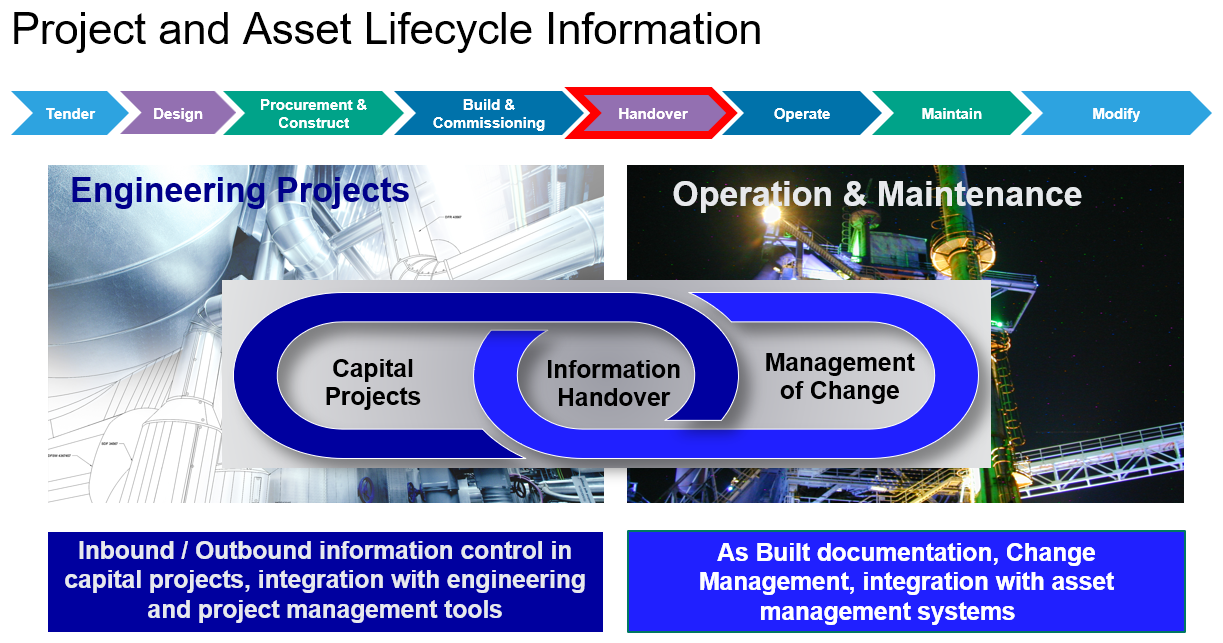
Figure 1: Engineering Information Management across the project and asset lifecycle. Capital Project Information Management and Asset Information Management are connected through Information Handover, while Management of Change keeps asset information aligned with the physical facility throughout Operations and Maintenance.
The figure above illustrates one of the fundamental principles of Engineering Information Management:
Engineering information must remain controlled and usable beyond the boundaries of an individual capital project.
The lifecycle can be viewed as a continuous sequence:
Tender → Design → Procurement & Construction → Build & Commissioning → Handover → Operate → Maintain → Modify
However, the way information is managed changes significantly along this lifecycle.
During the Capital Project, the primary objective is to create, exchange, review and control the information required to design and construct the facility.
During Operations and Maintenance, the objective changes. Engineering information has to support the safe, reliable and efficient operation, maintenance and modification of the physical asset.
Between these two environments lies one of the most critical EIM processes:
Information Handover
Information Handover transforms project information into information that can be used by the operating organization.
And once the plant is operating, Management of Change ensures that the engineering information continues to represent the actual physical facility.
The lifecycle therefore should not be understood as a simple one-way transfer of documents from a project team to an operator.
It is an information continuum.
Capital Project Information Management
On the project side, information is created by many organizations.
Engineering companies, EPCs, construction contractors, equipment suppliers, OEMs and other parties continuously produce and exchange engineering information.
Typical information includes:
equipment and tag data,
drawings and diagrams,
specifications,
calculations,
vendor documentation,
inspection and test records,
certificates,
correspondence,
review comments,
schedules and milestones.
Project Information Management therefore has a strong inbound and outbound information-control function.
Information arrives from suppliers and contractors, is reviewed and approved by the project organization and is subsequently distributed to engineering, procurement, construction and commissioning teams.
At the same time, the project issues requirements, drawings, specifications, comments and decisions to external organizations.
EIM has to control these information flows.
This requires integration with engineering applications, document-management systems and project-management tools.
For example, an equipment datasheet may simultaneously be related to:
an equipment tag → a supplier → a purchase order → an MDR item → a responsible engineer → a review workflow → a contractual delivery date → a construction milestone.
Managing these relationships turns isolated documents and data into managed project information.
Information Handover is the Lifecycle Bridge
Handover is often treated as an activity that occurs shortly before project completion.
From an EIM perspective, this is too late.
Information Handover should be designed at the beginning of the project.
The operating organization must define which information it requires, how that information must be structured and which quality criteria have to be fulfilled.
These requirements then have to flow into engineering contracts, supplier requirements and project information processes.
Handover consequently starts with:
Information Requirements
and continues through:
Information Planning → Information Production → Review → Validation → Acceptance → Handover
Only then can project information reliably become asset information.
The central objective is not merely to hand over a collection of documents.
The objective is to provide the operator with complete, structured, validated and usable asset information.
Asset Information Management
Once the facility has been commissioned, the information context changes.
Project organizations are typically structured around contracts, engineering disciplines and deliverables.
Operating organizations are structured around the physical asset.
Operators and maintenance personnel work with:
plants → systems → functional locations → equipment → components.
Engineering information therefore has to be connected to this asset structure.
An operator looking for information about pump P-101 should not need to know which EPC contract created the pump or which supplier document package originally contained its information.
The operator should be able to access the relevant information through the equipment itself.
That information may include:
P&IDs, datasheets, operating manuals, certificates, manufacturer information, design properties, maintenance instructions, spare parts and change history.
This is why Asset Information Management requires integration between engineering information repositories and systems such as Enterprise Asset Management (EAM) or computerized maintenance-management environments.
The relationship between engineering information and the physical asset becomes the organizing principle.
The three dimensions of EIM
Engineering Information Management can therefore be understood through three interconnected dimensions.
Information Content includes documents, structured data, models, metadata and technical objects.
Business Context describes who creates the information, who owns it, who reviews it, who approves it, when it is required and which contractual or project milestone depends on it.
Asset Context describes which plant, system, functional location, equipment item or component the information belongs to.
A mature EIM environment connects all three.
This allows an organization to answer questions such as:
What information do we have about this equipment?
Which information is still missing?
Who is responsible for delivering it?
Which revision is currently approved?
When is the information required?
Which project milestone depends on it?
Where is the authoritative information stored?
Has the information been updated following the latest physical modification?
These are fundamentally EIM questions rather than merely Document Management questions.
Author: Jens Friehmelt is a Senior Manager in OpenText Professional Services EMEA leading an international team that combines multiple OpenText technologies to serve customers with best-practice solutions for Engineering, Construction, and Maintenance processes.